Monday, 20 June 2016

VLSI Workshop


I got an opportunity to speak with the budding engineers on VLSI and it's Job opportunities.


please click on the below link for the slides.

Workshop Slides

Workshop Pics:


Will upload the Audio soon.

Tuesday, 14 June 2016

Handshake Mechanism : Driver or Sequence?


In this article, I am sharing my thoughts on whether the Response handling mechanism should be in Driver or sequence?
The most common form of sequence - driver use models is the scenario where the sequencer sends sequence item to the driver, which process the item to the pin level  protocol format and also the driver needs to respond to the pin-level information or send back the response to the sequence.

For example as shown in below figure the Protocol requires an ACK/NACK handshake from DUT after every 8 bits of data. Depending upon the Response the next set of action is taken place.
  

                                                                                                    Figure 1: Serial Protocol 


          For the above protocol format the state Machine logic is implemented in Driver. It is easy to have such a logic in driver than sequence. Let us discuss in detail.

Figure 2: State Machine Logic Implemented in Driver


 After analyzing, it was decided that for this protocol format the Response handling mechanism should be  in Driver than in sequence because of the following Reasons.

1) If we have Response logic in sequence, the user who uses the VIP has to have in-depth protocol Knowledge in writing sequences/test cases and sequence looks more complex and takes time in coding/debugging them.
                                    
                                
Figure 3:  Handshake Mechanism: Response Control in Sequence

2)   If we have Response logic in Driver, coding the sequence will become simpler but the driver logic is complex and sometimes we may require more flags to control the logic which will be bit confusing.

                                    Figure 4:  Handshake Mechanism: Response Control in Driver

A good VIP implementation shall consider such scenarios and arrive at a trade-off based on the protocol requirements.

Monday, 30 May 2016

System Verilog : Soft Constraints


 Soft constraints are default constraints which hold true until contradicted by another similar constraint.


Let us understand this concept with the following examples.

1.    We have a packet class with address variable, which is limited in between 10 and 100.

class packet;
 
  rand bit[7:0] address;
 
  constraint address_c {
    address inside {[10:100]};
  }
 
endclass

program test();
 
  packet p;
 
  initial begin
    p=new();
    assert(p.randomize());
    $display("address value is %0d" , p.address);
  end
 
endprogram


Output:  address value is 53


The output is 53 which is in between 10 and 100.

2.   Let us apply a inline constraint stating that address should be equal to 200.


class packet;
 
  rand bit[7:0] address;
 
  constraint address_c {
    address inside {[10:100]};
  }
 
endclass

program test();
 
  packet p;
 
  initial begin
    p=new();
    assert(p.randomize() with { p.address==200;} );
    $display("address value is %0d" , p.address);
  end
 
endprogram

Output: Error

Error-[CNST-CIF] Constraints inconsistency failure
testbench.sv, 19
  Constraints are inconsistent and cannot be solved.
  Please check the inconsistent constraints being printed above and rewrite
  them.

"testbench.sv", 19: test.unnamed$$_3.unnamed$$_1: started at 0ns failed at 0ns
                Offending 'p.randomize() with {
(p.address == 8'hc8);
}
'
address value is 0

The output is 0, here the randomization failed due to constraint conflict i.e. we have given an inline value for address which is out of the range i.e. in between 10 to 100, in such scenarios we need to switch off the corresponding constraints as shown below.

 class packet;
 
  rand bit[7:0] address;
 
  constraint address_c {
    address inside {[10:100]};
  }
  Which
endclass

program test();
 
  packet p;
 
  initial begin
    p=new();
    p.address_c.constraint_mode(0);
    assert(p.randomize() with { p.address==200;} );
    $display("address value is %0d" , p.address);
  end
 
endprogram


output: address value is 200

3.  Let us change the code slightly and use soft keyword before address variable in constraint block as shown below.

class packet;
 
  rand bit[7:0] address;
 
  constraint address_c {
    soft address inside {[10:100]};
  }
 
endclass

program test();
 
  packet p;
 
  initial begin
    p=new();
    //p.address_c.constraint_mode(0);
    assert(p.randomize() with { p.address==101;} );
    $display("address value is %0d" , p.address);
  end
 
endprogram


output: address value is 101


In the above code there is no need to use additional constructs like constraint_mode(0) , here the inline constraint of {p.address == 101 } will have the priority and the solver solves this instead of above declarative constraint ( constraint address_c { soft address inside {[10:100]};  } )

These soft constraints can be used to check the error/illegal scenarios.
 
 So the output here is 101.


 Happy Learning.

 Please provide your feedback if any.

Thanks,
Vikas Billa


Thursday, 31 March 2016

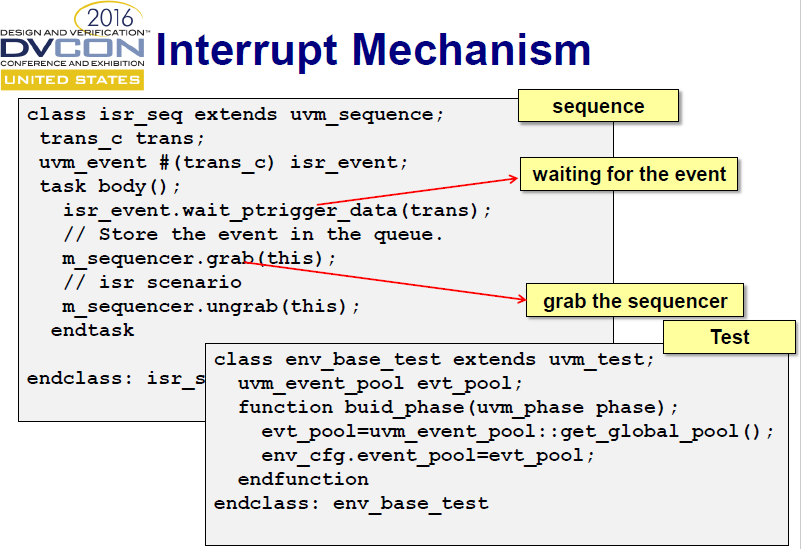
DVCON-16 Paper : A 360 Degree View of UVM Events : Presentation Slides

Paper:  A 360 Degree View of UVM Events

Presenting you the highlight slides for reference.

For full paper and presentation slide please do write to us.


Saturday, 27 February 2016

Solar System and Verification IP

The right process for a verification IP development is planning, development and closure. These steps are compared with the planets of a solar system. Each step in VIP development is assigned with a planet as explained below.

Figure 1: Solar System

Solar System
Verification IP
Sun
DUT
Mercury
Verification Plan
Venus
Agents Development
Earth
Testbench Development
Mars
Assertions and Functional Coverage Development
Jupiter
Test Cases Development
Saturn
Regression and Debug
Uranus
Fixing Testbench or Test cases
Neptune
Coverage Closure
Pluto
Release – User guide, Product Documents etc...

Table 1: Verification IP compared with Solar System

Further to above planets there are scary looking asteroids in solar system which are treated as bugs. These bugs may be DUT bugs or Testbench bugs.

                                        Figure 2:  Verification IP Development Steps

Thursday, 14 January 2016

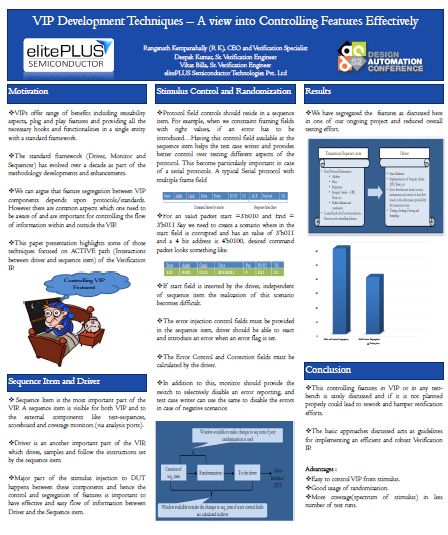
DAC - 15 : Poster Presentations

Please find the posters from the below link.

Paper Title: VIP Development Techniques – A view into Controlling Features Effectively

Link: VIP_Development_Techniques.pdf

Abstract:  VIPs offer range of benefits including reusability aspects, plug and play features and providing all the necessary hooks and functionalities in a single entity with a standard framework.

The standard framework (Driver, Monitor and Sequencer) has evolved over a decade as part of the methodology developments and enhancements.

We can argue that feature segregation between VIP components depends upon protocols/standards. However there are common aspects which one need to be aware of and are important for controlling the flow of information within and outside the VIP.

This paper presentation highlights some of those techniques focused on ACTIVE path (Interactions between driver and sequence item) of the Verification IP.


Paper Title: Developing Common UVM Testbench for Simulation and Emulation Platforms to Reduce Verification Effort Across Different Abstraction Levels

Link: Abstarction_Levels.pdf

Abstract: Today’s traditional verification flow involves verification at multiple levels of abstraction. So the testbench also needs to be adjusted/modified at different abstractions from transaction-level simulation, RTL simulation to hardware acceleration.

An ideal solution is to make use of an advanced, automated verification environment across different abstraction levels, which helps in enhancing the overall performance gain, productivity and faster verification closure.


Thanks for reading, please inbox me for any queries/suggestions


Friday, 8 January 2016

DVCON -15 India : A Reusability Combat in UVM : Callbacks vs Factory

Please find the poster at the below  link

UVM_Callbacks_vs_Factory.pdf


If you need full length paper or if you have any Questions please inbox me.